Survivor vs A Winged Victory for the Sullen
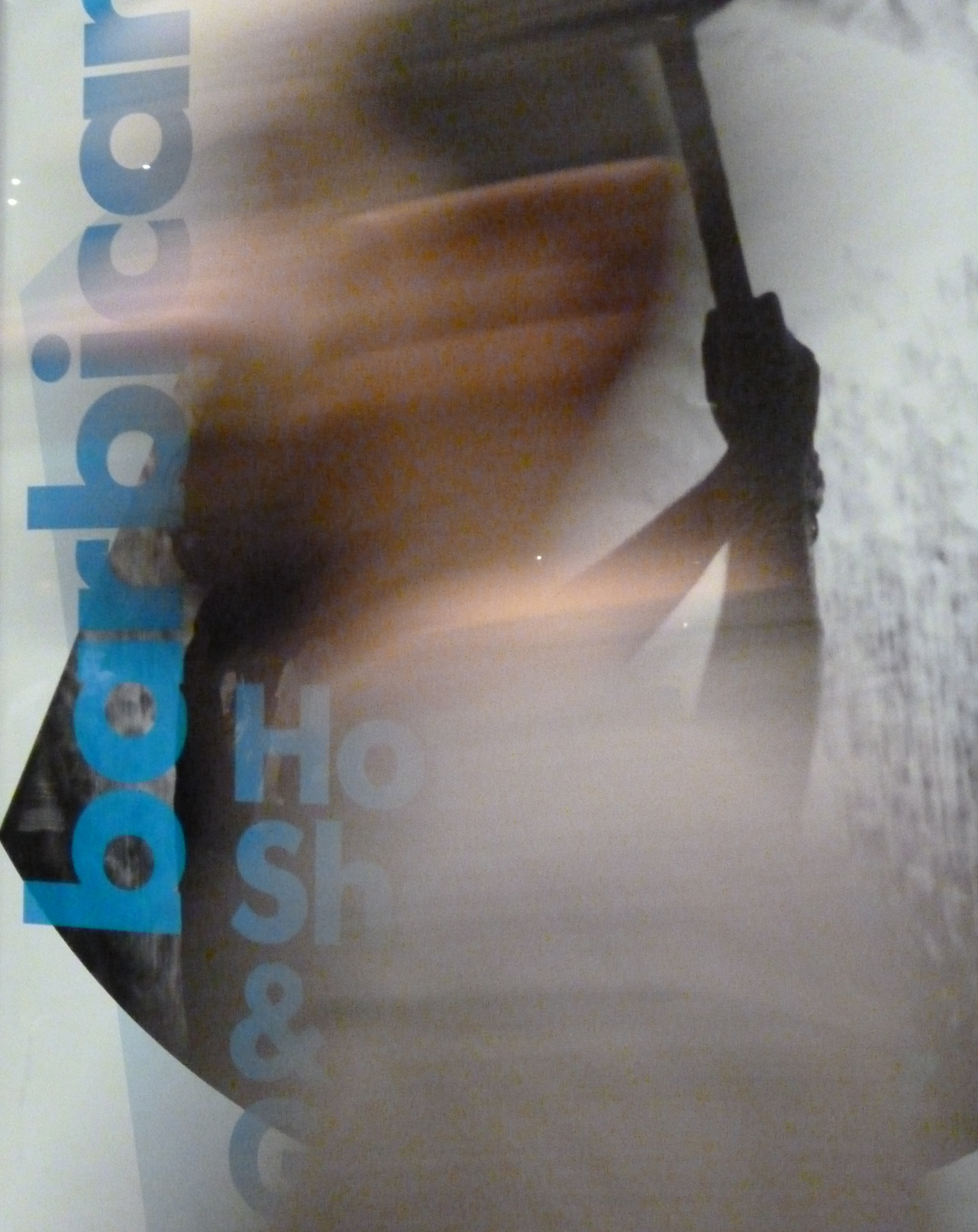
Two cultural outings for me last week; one outstanding and inexpensive, one outstandingly awful and outstandingly expensive…
The first offering was a trip to London to see the premiere of Hofesh Shechter and Antony Gormley’s Survivor at the Barbican, a performance piece billed (by the Barbican) as one of the cultural events of the season. Having seen the last piece Gormley collaborated on with a choreographer (the brilliant Zero Degrees) twice, I was fairly excited about seeing Survivor and paid for top price tickets to ensure good seats. The opening didn’t disappoint – the Barbican Theatre’s big metal curtains opened first to a eye-wateringly bright beam of light shone onto the audience, closed and then opened again to show a line of people, each barely illuminated from above by a single dim light…
… I’m afraid it went straight downhill from there. I won’t go into the painful hour and twenty minutes in detail but will mention the awful drummers, the ‘let’s film the audience and project it onto a big screen – won’t it be brilliant’ moments and the ‘here’s some footage of running water’ as being particularly memorable.
One comment has been that Survivor was like an end of year show from the local drama college and to be honest it was. It even looked like there were enthusiastic parents in the audience clapping wildly at the end.
However, on Saturday I went to see ‘A Winged Victory for the Sullen’ at Manchester Academy. AWVFTS is a collaboration between a composer called Dustin O’Halloran and Stars of the Lid’s Adam Wiltzie. I won’t attempt to describe their genre of music but it was incredibly beautiful and atmospheric and I left feeling uplifted and massively in awe of their talent. Go to Boomkat to listen to some of their tracks and read a review…
So… by the time the dogs had gone into kennels, the car had been filled with diesel, the congestion charge had been paid and we’d had something to eat, Survivor had suddenly cost two people eight times what A Winged Victory for the Sullen cost. Ho hum…
One more rant…Survivor cost everyone in the arts world a lot more than that, especially those of us that might be considering a grant from the Arts Council. £95,000 more…
Community Waste Fund – Waste Creative
Woodend Artists have been successful in gaining funding from Greater Manchester Waste Disposal Authority (GMWDA) to deliver Waste Creative, a project aimed at increasing awareness and knowledge about recycling and promoting the value of waste as a resource in our local community. Working with young people and residents from New Charter Housing in Tameside, Woodend Artists will run a programme of creative workshops and art events which will include designing an information pack, making an animated film and creating junk art and sculpture.
Richard Dawson and myself are the lead artists on the project and we were delighted to be successful in gaining funding to run Waste Creative. I think it’s a great way of getting the local community and young people involved in recycling in a way that’s interesting and creative. The project also includes a communal composting scheme and an initiative which will see local residents elected as Recycling Champions.
Waste Creative will culminate in a big launch and art exhibition at New Charter in Ashton-under-Lyne.
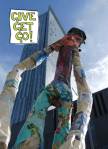
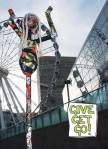
In the meantime, here’s some sculpture created from secondhand and waste materials which were produced in workshops run by Richard Dawson. The workshops were part of the GiveGetGo! Volunteering and Wellbeing Campaign I project managed and designed for Manchester City Council last year. I’ll post more on GiveGetGo! as this month a bus stop poster campaign designed by me is about to be run in Manchester city centre.


Planning a Creative Workshop: Part Two
A one-sheet sign-off form – a brilliant thing for ensuring both you and your client have all the relevant details for a new project or series of workshops. Don’t feel like you have to send it to your client – it’s just as useful as an internal tool too…
Get it here: One sheet sign off form
The application and interview process for freelance artists: part one
I’m currently working on a community art garden project in Bolton with Richard Dawson and Peter Castle. Having put in a (very long) proposal which took us about two days to complete, we got asked to attend an interview, which was then followed up by an ‘interview workshop’ when the interviewers (which included a community member) couldn’t decide between us and another group. We were paid to carry out this workshop, which I thought was a really positive approach, as I know many artists who have been expected to deliver a workshop for free as part of the interview process.
I’d be interested in hearing what other people think about the application and interview process for artists. You are often expected to submit a comprehensive proposal as an initial application, which can easily take a day or two to put together, and then attend first and second stage interviews, which might include a presentation, with perhaps a workshop thrown into the mix too.
All valid methods for finding the right person for the job or is it taking the selection process a bit too far?
Woodend Artists Winter Exhibition
Woodend Artists Winter Exhibition is a group show of work being exhibited at the Riverside Cafe in Uppermill from 30th November – 28th December. The cafe is open from Wednesday to Sunday every week.

This is the poster I designed for the Exhibition, alongisde a flyer and e-flyer.
Day Out at the Beach
Just a quick one this week…some of the Woodend Artists went on a trip to Formby yesterday for a walk on the beach with the dogs (that’s Harvey, Meg, Lara and Sir Percival Fuzzington), a third or fourth look at Antony Gormley’s Another Place (in the dark as it turned out!) and the preview of ‘The Imaginarium of The Bizarre and The Mysterious’ an exhibition by Woodend Artist member, Sue Platt.
Antony Gormley’s ‘Another Place’
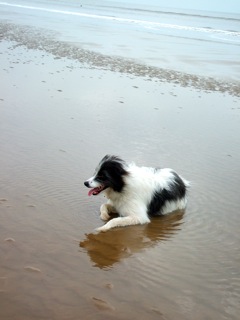
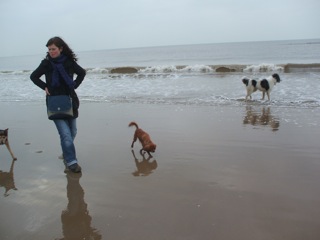

Thanks to Pat Baker for the images!
Planning a Creative Workshop
Planning a creative workshop
As discussed in my last post, I recently facilitated an ‘art walk’ around the beautiful Dove Stone reservoir in the Peak District, in collaboration with another artist Richard Dawson and the RSPB. It turned out to be a great day, really successful and I think everyone got something out of it. We had a great mix of people including regular visitors to the area and first-timers too.
However, doing a quick evaluation afterwards, there were some things that I would alter if doing again. This made me think about what preparation you need to run a successful workshop (especially if it’s one you haven’t done before) and how to avoid ALWAYS forgetting something. Please feel free to add your own suggestions too.
Five things to consider:
1. Outcomes and Expectations
I recommend having a face-to-face meeting with the organiser / your client. This allows you to properly discuss the workshop, what they expect, what they want the participants to get out of it, any necessary outcomes or information etc. Of course, time and budget constraints often prevent this but I would always attempt to meet. If not a telephone conversation is essential.
Items to discuss/consider with your client:
a. What you are going to do in the workshop
b. Why they are organising this workshop?
c. What their expectations are?
d. Do they have necessary outcomes?
e. Expected participants – see below
f. What the budget is and what this includes?
g. Is any support or extra help needed/required by law?
h. Timing – length of workshop, what time they can expect you to arrive, what time you’ll leave, access to room etc
i. Write down dates, times, number of sessions
2. Participants
As far as possible, check and confirm numbers, ages, skill levels of your expected participants. It might be worth discussing MAXIMUM numbers you can work with but always suggest bringing an assistant (if possible) if they want to increase numbers and the budget allows.
If it’s a drop-in or open workshop, think about limiting who can attend or applying conditions in the publicity and marketing. For example: ‘adults only’ or ‘children under 14 must be accompanied by an adult’. Remember – you’re not doing this to be difficult or restrictive – it’s to ensure that you can pitch the workshop at the right level and that participants get the most out of attending.
If it’s a workshop for an existing group or known participants, try to get as much background information as possible. If you can attend a session or meet the participants prior to your workshop, it can be hugely beneficial, especially if it’s a challenging or particularly demanding group, as you then know what to expect.
3. List of materials and equipment you need
The amount of times I have turned up at a workshop only to realise something has been left on the studio desk or (if I’m lucky) in the car, is too many to mention. However, I have also turned up with ten times as much stuff as needed and managed to cater for the totally unexpected – 75 people instead of 15 (this is true), somebody wanting to experiment with a different medium (don’t knock enthusiasm if you’ve got it) and getting through your exercises much too quickly.
So write a list. If you’re going to be doing a lot of similar workshops, do some laminated lists that you can re-use. This will eliminate the need to remember what you need to take with you. It’s also a good idea to have workshop basics in a separate box and ready to go. I keep disposable aprons, disposable gloves, protective goggles, baby wipes, paper towels, pencils, pens, blank paper (both big and small), post-it notes, pritt-stick and blue-tac ready to go as I will invariably need them at each workshop.
Also have some pre-prepared relevant exercises that can be used to fill time if necessary. What these are depend on age range, focus of group etc but it’s always good to have something up your sleeve!
4. Do a dummy run
I know…last thing you’ve got time for. However, even if you just run through the process in your mind step by step, it will help. It’s really easy to forget or miss something, especially when you are familiar with a process or medium but the participants are not.
5. Forms, information, documentation and evaluation
You’ll probably need to fill in a number of forms when facilitating creative sessions. Discuss what your client needs and think about what you need.
A one-sheet sign-off form is great for making sure that everyone understands the session, what it’s about, when it will start and finish, what’s expected etc. It also is a great thing to pass on to someone else for information or if you’re struck down with the flu and somebody needs to fill in for you. It doesn’t need to be an essay and can be adapted from session to session.
You’ll also probably need to fill in the usual attendance records, consent forms and evaluation information.
Take pictures, lots of pictures. Try and get someone else to do this job for you, as it’s almost impossible to run a busy workshop and document it at the same time.
Evaluation is a whole other issue in itself and needs to be thought about before the session and adapted to your participants’ needs. I’ll probably write more about this another time as it’s a massive subject!
The difficult second posting
Apparently, I should also include lots of pictures in this blogging malarkey so here goes…

This is a recent project I was involved with in Wilmslow, East Cheshire (just south of Manchester). For me, it was a great example of a successful community art project (in more ways than one) and I intend to do more of a write-up on it in a later post but for now – here’s a picture of the finishing touches being done to the artwork.
When I first became a ‘freelance artist’ (more on the terminology later), I had a good trawl through the internet looking for helpful info and books that would help me a). make lots of money, b). tell me how to find work and c). make a success of any work I did find. There’s lots out there about the money bit (but I think you’re in the wrong job if you’re doing it to get rich), how to network and make contacts and how to be successful at your job but there wasn’t much out there about what you actually do and are expected to do as a freelancer. Saying that, Artists Newsletter is a fantastic resource for artists so for anyone new to this game, first stop www.a-n.co.uk. Ooh, second stop really – read this first!
Thanks to Richard Dawson for the image.
Um…hello
If I had a pound for every time someone told me I should start a blog…
So – here it is. Weird. Apparently this is going to up my profile, make my website top of Google and bring me everlasting fame. Or something. Maybe I’ll need to tweet as well to achieve the fame bit…
Next step – choose what I’m going to write about. Hmmm – how about me? Though I find the subject endlessly fascinating I’m not sure others will so I’ve made a compromise. I’m going to write about…yes, you guessed it…’Being a Freelance Artist’ (that’s in the loosest possible sense, of course).
This gives me carte blanche to write about any aspect of my life but I’m also going to (hopefully) include lots of helpful stuff about different parts of being a freelance artist including doing community and public art, working with clients, inspiring art and design, money, what makes a successful project, managing your time and how to survive winter working from home without efficient heating (it’s a finely balanced method but involves two hot water bottles, elasticated trousers and tartan granny slippers).
(And tea, lots of tea)





 Being A Freelance Artist